
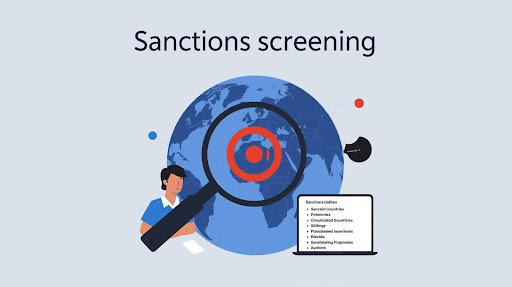
The use of sanctions screening is an essential tool that can assist organizations to ensure that they remain compliant in the world that is becoming more regulated. The companies conducting international trade, financial transactions or online transactions should make sure that they do not deal with individuals or entities that are under financial or trade restrictions. Proper sanctions screening does not only help save businesses against the imposition of penalties but also helps to show willingness toward ethical and legal conduct.
Conceptualization of Sanctions Screening
The sanctions screening is the screening procedure of inspecting customers, suppliers and third parties in relation to official sanctions lists that are provided by governments and international organizations. Such lists comprise individuals, organizations, and countries that are limited on the basis of activities such as terrorism, corruption or violation of human rights. Frequent screening assists companies to understand the possible risks prior to involving themselves in transactions and adherence to international standards and financial transactions.
Sanctions Screening Role in Compliance
Sanctions screening provides compliance frameworks with a strong tool against financial crime and regulatory violations. Devoid of it, businesses face hefty fines, depreciation of their reputation, and failure in operations. Banking regulators in most regions of the globe have asked financial institutions and companies to put in place excellent screening processes. This needs to be a regular, open, and dynamic process depending on the current regulatory developments to ensure compliance during national and international levels.
Combining Sanctions Screening and AML Programs
An extensive compliance system incorporates screening of sanctions into a larger framework of anti-money laundering efforts. AML screening assists in the identification of suspicious transactions and that the companies do not contribute to illegal transactions in terms of money. Together with the customer due diligence and risk assessment processes, it is a layered method of threat identification and handling. Integration also encourages effective data sharing and the accuracy of risk detection is improved.
Secondary Sanctions Screening and The importance of it
The role of secondary sanctions screening has been becoming more relevant with the development of the complexity of international relations. In comparison to primary sanctions, which explicitly impair dealings with particular entities, secondary sanctions are imposed on the ones that deal with the groups under sanctions indirectly. This poses more compliance problems to the multinational companies. Tracking of these auxiliary risks assists the businesses to prevent the unwanted breaches and retain secure and proper business relations in various jurisdictions.
The use of Technology in Sanctions Screening
Compliance in this day and age requires quick and efficient screening. Sanctions screening software will conduct automated screening on multiple international lists, which is time-saving and minimizes the human error. These tools have the ability to instantly analyze the customer data and transaction history and issue red flags on possible matches to be considered. Automation enables firms to effectively expand their compliance activities and ensure uniformity in high quantities of data, a critical consideration to multinational organizations.
Advantages of Sanctions Screening Software
- Enhances the efficiency of screening that is repetitive.
- Improves the precision and minimizes false positives.
- Secures the real-time tracking of the updates of the sanctions.
- Offers a central auditing and regulatory review reporting.
- Enables superior decision-making using advanced analytics.
Sanctions screening software assists companies to remain in line with dynamic regulations without placing an excessive burden on the compliance departments.
Sanctions screening has several challenges
Sanctions screening is very significant but has a number of challenges. Data accuracy is one of the key problems. Matches and alerts may also be false due to the presence of outdated or incomplete customer information. The other issue is cross-border compliance which is not easy to control with the regions having different types of sanctions which they have. It is also necessary to educate the staff of the business to interpret the screening results correctly and make sure that every alert is investigated and addressed accordingly.
Best Practices in the Screening of Sanctions
They should distribute effective screening mechanisms backed by straightforward policies and frequent audits in organizations. The information must constantly be revised to correspond with the recent sanctions lists, and screening tools must be checked on accuracy and dependability. It is also important to train employees and make them realize the significance of screening and how to act on the possible matches professionally. These practices enhance compliance, as well as minimizing chances of financial or legal liability.
The Global Effect of Sanctions Screening
Sanctions screening assists in global terrorism financing prevention, organized crime, and corruption. It helps in economic stability and confidence within the financial system by ensuring that businesses operate within the international regulations. The responsible business practices and strengthening integrity of global trade and financial networks are also encouraged by effective screening. The adherence to the compliance of sanctions enhances the corporate image and international security.
Conclusion
Sanctions screening is a very crucial section of international compliance and financial honesty. It protects companies against interaction with limited parties, contributes to compliance with international laws, and promotes the level of trust between regulators and partners. With the help of sophisticated sanctions screening software, incorporating AML sanctions screening, and meeting secondary sanctions screening needs, organizations can create strong compliance models. Sanctions screening is still one of the pillars of ethical and legal business practices in a modern global environment, which changes rapidly.
