
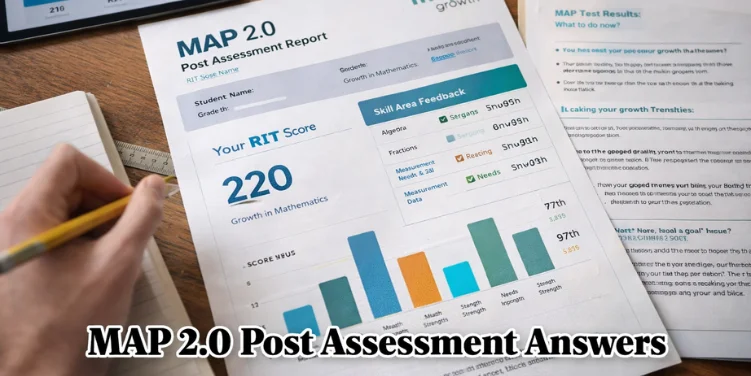
I’ll be honest — in 2026, the searches around MAP 2.0 post assessment answers haven’t slowed down. If anything, they’ve increased. But here’s what most people get wrong: students aren’t just looking for “answers.” They’re looking for clarity.
I’ve seen it firsthand. Students staring at their RIT scores, unsure whether to feel proud or disappointed. Parents refreshing portals, wondering what that number actually means for their child’s future. Even teachers trying to translate technical score reports into everyday language. The real frustration isn’t about difficulty — it’s about the gap between results and understanding. And that gap is where confusion quietly grows.
What many people don’t realize in 2026 is that MAP 2.0 post assessments aren’t designed like traditional exams. They aren’t about memorizing the “right” answers. They measure growth, learning patterns, skill depth, and progress over time. It’s an adaptive system. It adjusts. It analyzes. It evaluates development, not just correctness. Yet this crucial detail is rarely explained in a way that feels human and practical.
Because of that silence, assumptions take over. Students think they “failed.” Parents assume something is missing. Online forums are filled with partial explanations and recycled advice that doesn’t truly solve the problem. And the cycle continues — more searching, more guessing, less clarity.
That’s exactly why this topic needs to be unpacked differently.
No heavy academic jargon. No overcomplicated terminology. No vague summaries copied from score guides. Just a clear, honest explanation of how MAP 2.0 post assessment answers work, what the results are actually measuring, and how to use those insights in a meaningful way. When students and parents walk away feeling informed instead of overwhelmed — that’s when the explanation has truly done its job.
Understanding MAP 2.0 Post Assessment
MAP 2.0 is not a school test but rather an organized measurement system, which aims at assessing the progress of learning following instruction. The post assessment stage is the one that is used to determine the extent to which a student has internalized something with time. This assessment is not an isolated recall, as opposed to practice quizzes, which are cumulative.
When people search for Map 2.0 post assessment answers, they are often trying to decode results rather than bypass the process. That distinction matters. MAP 2.0 answers are constructed based on the demonstration of skills and not on memorization. Every response relates to one of the learning objectives, be it problem-solving, comprehension, or applied reasoning.
This framework can be followed so as to eliminate redundant anxiety. The test is not aimed at catching students off guard; it is aimed at showing the trends. When such an attitude changes, post-assessment responses will cease to be a mystery and begin to be applied.
Why Students Look for MAP 2.0 Post Assessment Answers
Let’s be honest. The majority of students are not searching for assessment answers due to laziness. They seek out, as they do not like not knowing something. There is no complete score without an explanation of it, and it seems unfair. Students would like to understand why an answer was or was not working.
MAP 2.0 post assessment answers are often misunderstood as fixed solutions. As a matter of fact, they are reasoning lines. That is why two students may come to different conclusions but represent equally good skills. This subtext is hardly clarified in a straight manner, which contributes to the confusion.
It is also pressured- academically, parentally and personally. Grades still matter. Progress reports are still important. Wanting clarity is natural. The actual problem is not the curiosity, but the way the curiosity is handled. The stress that learning technology causes when presented as an answer rather than a verdict is reduced, making the whole assessment process more fruitful.
How MAP 2.0 Post Assessment Answers Are Structured
MAP 2.0 post assessment answers follow a deliberate structure rooted in adaptive testing logic. Questions are scaled according to the performance of the students, and this implies that not all students give similar answers. This alone is the reason why official answer sheets are so uncommon.
Both answers fit within a competency band as opposed to one correct answer. As one example, a math question can have a variety of strategies to solve it, but the grading can be based on the ability of the reasoning to match the level of skill expected. That is why it is necessary to consider the context of answers.
There is a tendency among students to want the traditional right or wrong validation. MAP 2.0 does not necessarily work like that. The system appreciates the manner in which a response is arrived at, and not at its result. The knowledge of this structure can help the students to interpret the results properly and not to misjudge their real performance.
How to Review MAP 2.0 Post Assessment Answers Properly
Reviewing MAP 2.0 post assessment answers is less about checking boxes and more about identifying trends. One wrong response hardly makes one a weak person. Patterns do. And there real insight hath its seat.
Feedback reports, rather than uncooked questions, begin an effective review. Such reports identify areas of skills shortage, growth opportunities, and preparedness. It is easy for students to lose the bigger picture when they jump directly to the answers. This is familiar to the educators, yet not always taught to students on how to interpret.
Nothing is as practical as having one good place and two good places and one area of improvement. That balance preserves the motivational level and, at the same time, motivates the progress. When responses are viewed as feedback and not failure, the students are given a clear picture and not frustration and learning indeed sticks.
Common Mistakes Students Make After Post Assessment
One common mistake is treating MAP 2.0 post assessment answers like final verdicts. They’re not. They’re diagnostic signals. Their misinterpretation may make students pay attention to the inappropriate things.
The other problem is memorizing answers. There are students who feel that it is best to repeat the same questions, as this will assure them of better performance in the future. Regrettably, this strategy cannot be effective because of the adaptive nature of MAP. The system changes, not the memorized answers.
An even smaller error is not one that acknowledges some success. Students tend to forget about the positives and concentrate on mistakes. That mindset slows progress. Development occurs at a better pace with knowing strengths and weaknesses. Being aware of these traps assists students in utilizing assessments in a constructive rather than a defensive manner.
MAP 2.0 Post Assessment vs Pre Assessment
Not only timing but also intent is involved in the difference between pre and post assessment. The starting points are measured by pre-assessments. Measurement of transformation is accomplished through post assessments. Such a difference determines the way of answering.
Uncertainty is likely to be tolerated by pre-assessment answers. They’re exploratory. Instruction-based learning, however, is reflected in the post assessment answers. There are higher expectations, and there are high contexts. The interpretation of post results by teachers is curriculum exposure.
There is always the unfair comparison of the two among students. The fact of receiving a lower post score may be disheartening, although there could be improvement in more difficult skill areas. Knowledge of this contrast avoids misunderstood information and can teach students to value improvement, going beyond the superficial numbers.
Are MAP 2.0 Post Assessment Answers Publicly Available?
Brief response: No, not as many people would like. MAP 2.0 post assessment answers are not published as universal answer keys. It is no secret, it is planned. Adaptive assessments become meaningless when the answers suggested with the help of static become circulated.
Schools can offer reviewing sessions, a summary of feedback or guided discussions. Raw answers are never as useful as these anyway. They are preoccupied with reason, but not imitation.
The discovery of leaked answers also makes searching result in old-fashioned or inaccurate information. Worse still, it may give false confidence. It can be obtained through a reliable understanding based on official feedback channels and considerate review, rather than shortcuts that are not in line with the actual functioning of the system.
How Students Can Improve Using Post Assessment Feedback
The brightest brains do not even ask questions like, What was the answer? The question they put is, What does this result tell me? A change in that way of thinking transforms everything.
Targeted practice is effective when used to accompany the post assessment feedback. You do not need to review all of it, but rather one gap in skills at a time. Improvement is quantifiable and inspiring. This method is frequently suggested by teachers since it is based on how MAP follows progress.
This is clarified by a brief personal example. One of the students had a problem with reading comprehension, even though his scores were not that low. They also dwelled specifically on inference questions after going through post assessment feedback. In a few weeks, an understanding was gained not due to answers, but due to awareness.
Why MAP 2.0 Post Assessment Answers Matter Long-Term
MAP 2.0 post assessment answers don’t just affect a single report card. They also affect the placement, learning plans, and instructional strategies. This is why it is so important that accuracy and interpretation are considered.
This data is used by schools in order to customize learning. Opportunities may be lost when responses are misconstrued. As long as they are interpreted well, students get support that is well deserved.
Academic progress takes time and is based on reflection, rather than perfection. MAP 2.0 is aimed at upholding that philosophy. Those students who think about results rather than just getting scores achieve more than that.
Frequently Asked Questions
Can students see their MAP 2.0 post assessment answers?
Feedback summaries are normally provided to students instead of giving complete answer lists. This acts as a way of concentrating on talents as opposed to memorization.
Are MAP 2.0 post assessment answers the same for everyone?
No. The assessment is flexible, meaning that the questions and answers accepted by the students differ.
Why don’t schools release full answer keys?
Since MAP is an assessment of reasoning and development, as opposed to fixed responses. Accuracy would be lowered with answer keys.
How should parents review post assessment results?
Targeting trends, strengths, and areas of growth, as opposed to single errors.
Do MAP 2.0 post assessment answers affect future placement?
Yes. Outcomes tend to inform teaching and learning goals.

2 Comments
Pingback: hello world
Pingback: finasteride