
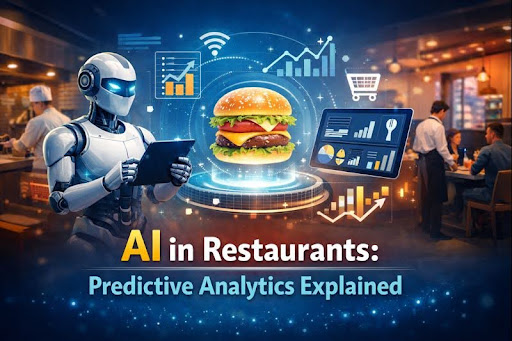
The restaurant business is an industry with stiff competition and as a result, it is highly essential to be on the frontline. As the demands of the customers increase and the needs in the area of operations become more complicated, restaurateurs are resorting to AI-based predictive analytics to automatize the operations and make decisions that are more informed and data-driven.
The AI-driven predictive analytics within the restaurant industry helps the owners, managers, and chefs to make more informed decisions in the context of inventory management, menu pricing, demand forecasting, and customized customer experience. Another important use of predictive analytics is the AI-Powered Location Intelligence that enables restaurants to work with geographical data to comprehend the behavior of customers, deliveries, and high-demand areas to expand into.
The blog discusses the power of AI and predictive analytics in restaurants that will demonstrate the primary examples of such use and practical applications to redesign the work of restaurants.
Predictive Analytics in Restaurants?
Based on past information, machine learning algorithms, and forecasting statistical models, Restaurant Data Analytics is based on predictive analytics to predict future trends and customer behavior. This covers predicting the demand of customers, optimizing inventory needs and supply chain operations in the restaurant industry. Data-driven insights provide restaurants with an opportunity to minimize waste, increase efficiency, and make smarter business decisions.
It is possible that using past activities, such as preferences of customers, their ordering strategy as well as seasonality, AI tools can determine their future activities. This helps the restaurants to make good decisions, reduce wastage and profit.
Important Areas of Influence in Restaurants:
Inventory Management: A.I programs predict inventory levels on the stock and ensure that restaurants have enough stock without being overstocked.
Demand Forecasting: Customer foot traffic, seasonal demand and sale are predicted to ease the staffing and other resource requirements.
Menu Optimization: This is where AI analyzes and proposes the most frequently ordered dishes or proposes a menu price change to maximize profit.
How Predictive Analytics could be used to increase operations effectiveness.
Among the most significant benefits of predictive analytics use in restaurants, one can single out the opportunity to achieve the higher performance of the operations as the waste reduction, proper use of the resources, and the more effective staffing.
Inventory Management Optimization: Predictive analytics applications are used to evaluate past buying trends, which assists the restaurants to have a better outlook of what to purchase. AI ensures that operations are not overstocked or become unable to supply essential ingredients, which would, thus, make the operations smooth, cost-effective, and waste-free.
Optimization of staffing: Predictive models can be used to predict the busiest times of the day, and through this, the restaurant owners will know how to schedule their staff effectively. Knowing the demand trends, restaurants could avoid staff overstaffing in slow periods and staff understaffing in rush periods, which would guarantee the high quality of customer service without sacrificing labor expenditures.
Supply Chain Management: Predictive analytics may also be used to simplify supply chains making predictions about changes in ingredient costs or outages. This empowers restaurants to predict changes in advance in order to prevent supply chain upheavals that may affect their capacity to address customer demand.
Improving Customer Experience through AI.
Customer experience is the main ingredient of the success of any restaurant, and the predictive analytics based on AI is changing how the restaurant and their customers relate to one another.
Tailored Dining Experiences: AI can be used to propose a personalized menu, dishes, or offers based on the information regarding the customer, such as previous eating habits, preferences, and dietary restrictions. To give the example, AI may also prescribe contents on the menu to a returning consumer and these are in respect to their previous orders, which increases customer satisfaction and drives them into doing business with you again.
Customer Wait Times and Reservation Systems: AI-based reservation systems are able to forecast peak eating periods and optimize the reservation procedure and cut down on waitings of clients. Also, the systems are capable of automatically modifying the reservations to accommodate no-shows or changes at the last minute without causing inconvenience to the customers.
Real-Time Feedback Analysis: Predictive analytics can also measure customer sentiment in real-time through review and feedback analysis. This information assists the restaurants to act fast to meet the needs of their customers in enhancing the overall services and retaining the customers.
Menu Engineering and Pricing Predictive Analytics.
Menus and prices are very important in the profitability of a restaurant. Using AI and predictive analytics, restaurants will be able to study customer behavior and make informed choices on menu items and prices.
Menu Optimization: Predictive analytics can be used to examine customer preferences and ordering behavior and suggest menu design modifications. As an example, it is possible to determine which meals are most in demand and those that are not performing well to make changes and sell the most and ensure customer satisfaction.
Dynamic Pricing: AI can be applied to dynamic pricing too where menu prices change according to variations in demand. As an illustration, in times of low business, a restaurant can lower the prices of some products to have more business, and the same price can be set higher during the busy hours.
Profit Maximization: Predictive models have the potential of assisting restaurants in determining the most viable food in the menu, and can aid in maximizing the menu itself, and the pricing approach. Restaurants can increase their overall profitability by specialising in high-margin products and pushing the underperformers, through promotions.
Practical Applications of Predictive analytics.
Some of the restaurants have already adopted predictive analytics to streamline their business and improve the customer experience.
Domino Pizza: Predictive analytics can enable Domino Pizza to monitor customer needs, predict demand, and find optimal delivery paths. Their artificial intelligence based order system recommends menu items to their customers through past orders, which enhances their convenience and sales.
McDonalds: McDonalds relies on AI-driven solutions to forecast the required inventory, supply chains management, and customer experience. They also apply AI to assist in optimization of their menu, which assists in adding new products depending on trends of customers.
The Cheesecake factory: The Cheesecake factory does predictive analytics to maximize menu pricing. Through the historical sales data they are able to manipulate the price to suit the trend of the demand which enhances the customer satisfaction as well as the profit margin.
Those are evidence that AI-based predictive analytics is already bringing significant value to restaurants, making them more efficient and profitable, as well as increasing the overall customer experience.
Difficulties and Issues.
Although predictive analytics is very beneficial, restaurants must know that there are dilemmas related to the implementation of AI solutions. These may include:
Data Quality: The predictive analytics should have the right data which is accurate and of good quality to be effective. The restaurants ought to ensure that their data collection strategies are powerful and effective.
Cost of Implementation The long-term outcomes can be substantial, but in the meantime, initial investment in AI technologies can cost a lot. Restaurants will have to analyze the predictive analytics tools on a cost-benefit basis.
Staff Training: The staff should be trained to effectively introduce predictive analytics because one cannot interpret the insights without proper training to utilize the new technologies.
Nevertheless, all of this notwithstanding, the fact that the adoption of AI has significantly increased in the restaurant industry demonstrates that the benefits far outweigh the costs, which is why predictive analytics is a sensible investment to undertake in the future.
Conclusion
With predictive analytics, the restaurant industry is transforming into an industry that makes smarter, data-driven decisions in all of its spheres of activity. Whether it is the ability to make better inventory management choices and reduce staffing optimization or improved customer experiences and profit maximization, AI-based predictive analytics offers a competitive advantage that restaurants cannot overlook. With the implementation of these innovative technologies, on the one hand, restaurant owners will be able to not only be ahead of the curve but also provide their customers with more personalized, efficient and profitable dining experiences.
Since the restaurant business is undergoing constant transformation, predictive analytics will be at the center of the future development of dining.
