
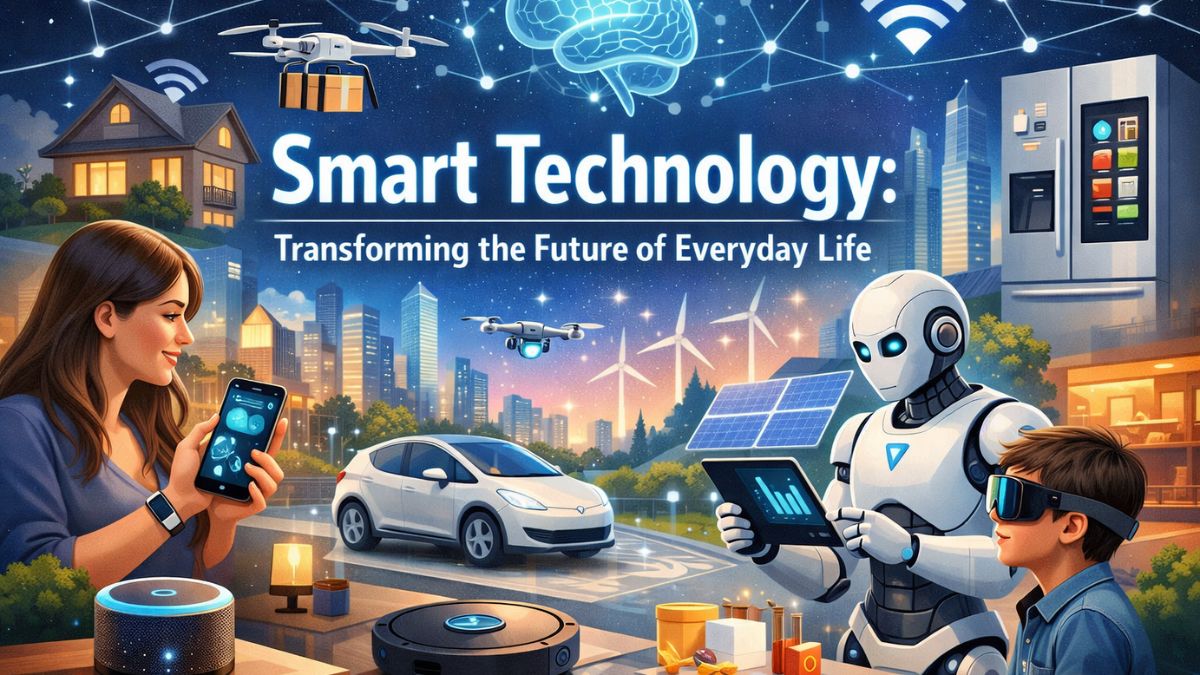
In the contemporary digital environment, intelligent technology is changing how individuals live, work and deal with the surrounding. Technology is getting smarter and connected as smartphones and smart homes become increasingly close than ever. The advent of intelligent technology has simplified the daily chores and made them quicker and more effective. The future of living is being defined by the modern innovations that are either voice-controlled home appliances or health tracking wearables.
Artificial intelligence, automation, Internet of Things (IoT) are major contributors to the speedy advanced smart technology. These technologies enable machines to interact, and make decisions without necessarily having to involve a human being. This has led to an increased convenience and connectedness in the life of the people.
Smart Technology in Homes
The modern smart house is one of the most obvious and well-known applications of smart technology. Smart homes are designed with interconnected devices to enable them to manage light systems, security systems, heating, and appliances with remote access by use of smartphones or voice assistant programs.
Indicatively, smart thermostats have the ability to regulate the room temperature depending on the user needs. Smart lights can be operated by voice command to turn on or off, and smart security cameras enable the homeowners to observe their houses no matter the location in the world.
This application of smart technology does not only enhance convenience but also aids in conserving of energy and enhancing security of the home.
Smart Technology in the Healthcare Industry.
Another area that smart technology is having a massive impact can be seen in healthcare. Fitness trackers and smartwatches are wearable gadgets that enable one to check the heart rate, physical activity, and sleep patterns. There are also sophisticated medical tools, which doctors can use to monitor the health of patients in real time through the use of smart systems.
There is a growing trend of hospitals using smart technology in enhancing the diagnosis, treatment and patient care. Medical data can be analyzed fast using artificial intelligence to identify the diseases in the initial stages and suggest more effective treatment schemes to doctors.
With the further development of healthcare, smart technology will even contribute to the enhancement of the quality of life of millions of individuals.
Smart Technology in Transportation.
Smart technology is also making tremendous impacts to the transportation systems. The cars produced now are fitted with intelligent navigation systems, sensors, and safety measures that can enable motorists to prevent road accidents and minimize the time taken to reach their destinations.
One of the most interesting inventions in this field is self-driving cars. These cars have some of the latest smart technologies like machine learning and sensors to analyze the environment and navigate safely without human intervention.
The transport system is also becoming smarter. Intelligent traffic management systems are being implemented by cities in an attempt to ease congestion and enhance efficiency in travel.
Education: Smart Technology.
The smart technology is swiftly transforming education. Through digital classrooms, online learning platforms and interactive tools, students learn anywhere in the world.
The teachers are now able to employ smart technology, including virtual simulations, smart boards, and AI-driven systems of learning to make the lessons more meaningful and productive. Students would have access to learning resources through the internet, interact with other students and study at their pace.
A new opportunity of personalized learning and global access to education will be introduced with use of smart technology as the technology is going to evolve as it keeps on advancing.
Advantages of Intelligent Technology.
The development of intelligent technology has numerous advantages enhancing the daily life. Among the greatest benefits is convenience. Individuals are able to automatize, even remotely operate the devices and save time during their daily activities.
The other significant advantage is efficiency. Intelligent systems are able to process data within seconds and make judgment that enhances productivity at home, businesses, and industries.
The smart technology also enhances safety. Smart security, health, and monitoring systems, and transport solutions assist to safeguard people and avoid possible risks.
Issues of Smart Technology.
Although smart technology has numerous benefits, it is also associated with a number of challenges. The key issues include privacy and data security since smart devices are gathering a lot of personal data.
The cost of smart systems implementation is another problem; this can be a costly exercise as it may cost some individuals and businesses. Furthermore, there is a tendency to contact with each other less frequently because of dependence on technology.
Nevertheless, with the ongoing technological development, programmers are trying to address these issues and ensure smart technology is safer and more convenient.
The Future of the Future of Smart Technology.
There are so many promising aspects of smart technology in the future. Artificial intelligence, robotics and connection innovations will keep changing both industries and daily experiences.
Fully automated homes, high-tech healthcare monitoring systems and smart cities are some of the features that could be witnessed in the years ahead because of smart technology. Such developments will make the world a more efficient, sustainable and connected world.
With society still adopting innovation, smart technology will still be an instrument in the future of ordinary living.
FAQs
What is smart technology?
Smart technology refers to devices and systems that use artificial intelligence IoT and automation to perform tasks automatically and improve convenience in everyday life.
How is smart technology used in homes?
Smart homes use connected devices such as smart lights, thermostats and security cameras that can be controlled remotely using smartphones or voice assistants.
Why is smart technology important for the future?
Smart technology improves efficiency, safety and convenience in areas like healthcare transportation and education making daily life easier and more connected.
