
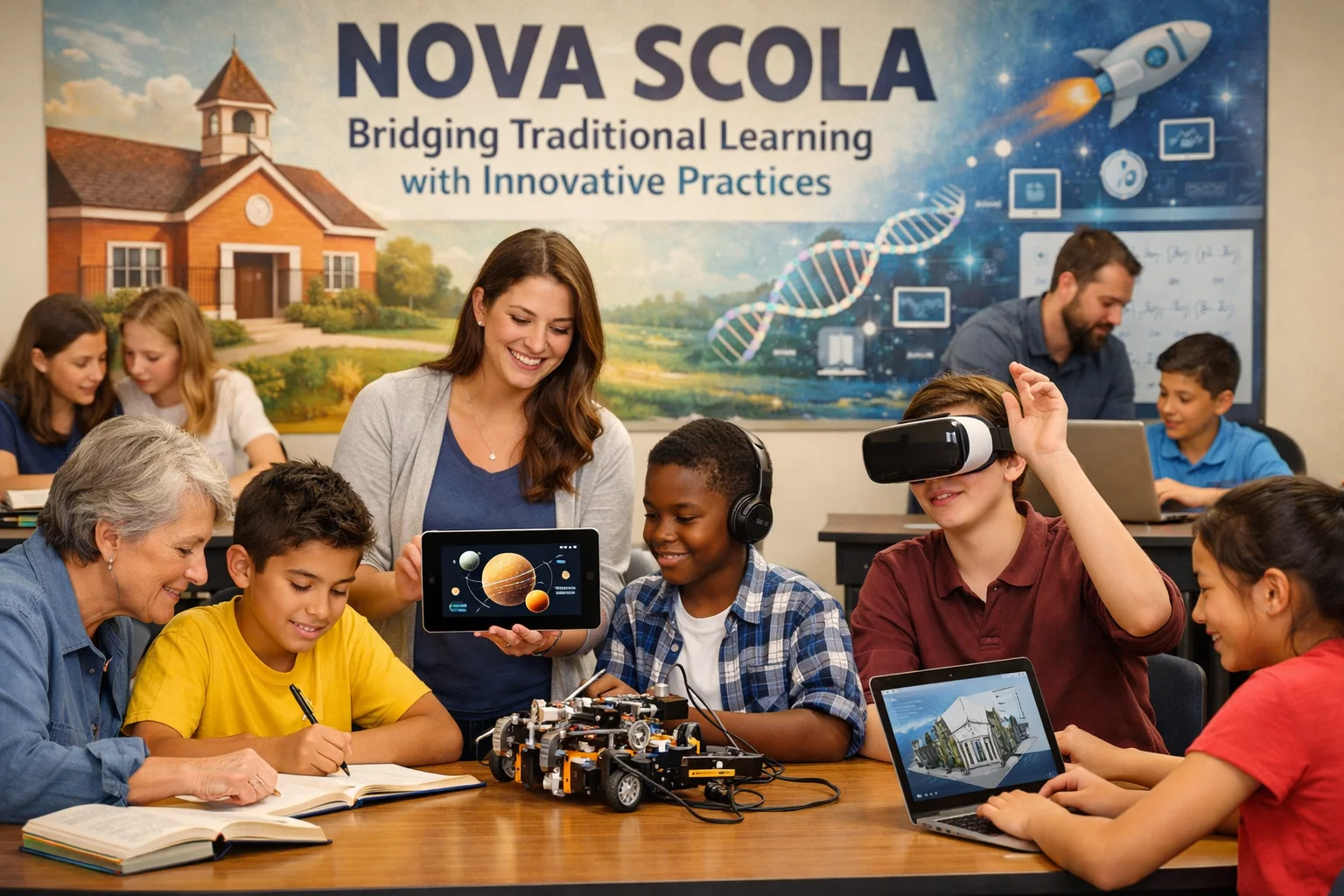
The first time I came across Nova Scotia, I knew that it was not some other name that was floating around the web. It is a new way of learning that incorporates structure through flexibility, which many other traditional systems can hardly provide at the current time. Nova scola is more of a reaction to the actual development of education, rather than its past, and that is why it is discussed the way it is, and people treat it as they do. That was the change that struck me at once.
Being a close observer of the educational changes and the models of digital learning, I have observed that it has altered the expectations of students, parents and teachers as well. The population desires to be understood, accessible and with value, rather than old-fashioned approaches and empty promises. It is there that platforms and ideas like this are unique, in that they strive to address actual issues rather than merely being fads.
In this guide, I want to simplify things to earth level. I will discuss what Nova Scola is, how and why it is becoming popular at the moment. No nonsense, no sophism. Simple truths, sensible discussions, and what kind of information I would prefer to hear myself before committing to an unfamiliar thing or spending time on it.
What Is Nova Scola and Why It Is Gaining Attention
Nova scola is a contemporary educational system in which a structured approach to learning is given priority, though flexibility in personal development is allowed. This model is flexible to the needs of the learners, unlike a traditional one that has a high dependency on fixed schedules and the one-size-fits-all approach to teaching, without compromising the academic direction. It is that equilibrium that is leading to an increasing number of people becoming interested in Nova Scotia among students, parents, and educators seeking viable solutions.
The focus is due to a straightforward question that many people are posing: why should learning be something left behind, as all other aspects have developed? Nova scola solves this frustration through clarity, progression and relevance.
It focuses on learning instead of remembering and development instead of stress. This approach is an obvious one as more families and institutions seek education that would meet real-life needs. It does not appear experimental, and this creates trust and long-term appeal.
The Vision and Philosophy Behind Nova Scola
Nova scola at its best is fueled by a philosophy that the learning process must be meaningful, accessible and flexible. The vision is shifting towards the old-fashioned academic traditions and instead the culture of curiosity and order living in coexistence. Instead of compelling the learners to be absorbed in a system, the system is created with the aim of accommodating the way that people learn in the long run.
This kind of philosophy is the one that appreciates progress as opposed to perfection. Errors are considered a development aspect but not a failure. Consistency is also promoted in Nova scola whereby learners are made to have good foundations before they proceed. Such an attitude is attractive to both the teachers and the family members who prefer long-term outcomes over quick performance.
Through the correspondence of education with the actual cognitive growth and applicability, the philosophy of Nova Scola is founded, considered, and prospective. It is not the speed, but the sustainability or, in other words, that is why it finds a reflection in contemporary education discourse.
How Nova Scola Works in Practical Learning Environments
Practically, Nova Scola is a structured but flexible learning framework. Each stage is directed by specific learning goals, though the pace may vary according to the progress of a learner. This enables the learners to thoroughly understand the concepts before proceeding, thus eliminating gaps that generally arise in the conventional systems. Teachers are more shown as facilitators than teachers, and they facilitate knowledge instead of merely presenting it.
In Nova Scotia, assessment is concerned with understanding and implementation rather than rote testing. Feedback is a bigger contributor to grades alone. This is a practical way of learning, and this makes learning less intimidating. The structure is similar whether applied in a traditional classroom or an online environment. That consistency would aid learners to gain confidence with retained freedom. Combining clarity and flexibility, Nova Scola transforms theory into a form of something really applicable in practice in the real educational setting.
Key Features That Make Nova Scola Different
Nova Scola has a number of characteristics that distinguish it from traditional education models. Among the most obvious ones, its focus on clarity can be mentioned. Learners understand the subjects they are learning, the reasons and how it relates to the overall objectives. This openness decreases the level of confusion and adds interest with time.
Flexibility without chaos is another excellent characteristic. Although the learners are given space to develop at their own pace, the system has a clear organization to ensure that there is no stagnation. There is also encouragement of collaboration that will enable learners to acquire communication and problem-solving skills naturally.
This framework is usually supported by technology, although this does not replace human guidance. Instead, the tools are employed in a wise manner to advance learning as opposed to overloading it. All these characteristics make the environment purposeful, helpful, and actually productive.
Who Nova Scola Is Designed For
Nova Scola is not targeting a specific demographic but a very broad one. It is a system that helps students who cannot take the strict structure relax. Simultaneously, high performers enjoy the possibility to advance further in their studies without the need to reiterate unnecessarily at the same time. The parents like the transparency and clear picture that the system gives them, particularly when it comes to tracking progress.
Nova Scola is also beneficial to educators as it does not make their job complex. Teachers will not have to deal with pressure at every moment; instead, they will be able to concentrate on the critical teaching.
The institutions that consider contemporary models of education view it as an opportunity to remain relevant and, at the same time, remain academic. The above general attractiveness is one reason why Nova Scola is increasingly popular in various learning settings. It is not abstract and exists without being rigid, without being out of order.
Educational Benefits of Using Nova Scola
Nova Scotia has more than academic performance advantages. One of the most significant benefits is that it is less anxiety-inducing to learn. Confidence is built automatically when learners get to know what to expect, and they go at a pace that they feel comfortable with. Such trust usually results in improved memorization and comprehension of topics.
The other significant advantage is the development of skills. Nova scola teaches thinking critically, communicating and being flexible, which are essential not only in the classroom. Students are also taught how to study, not what to memorize. In the long run, this develops a sense of independence and self-motivation.
Parents and educators often observe better attention and fewer misunderstandings. Nova scola offers these advantages, which make it more attractive as an alternative, but as a long-term educational policy, centered on tangible results.
Nova Scola vs Traditional Learning Models
Nova Scotia points out some noticeable differences when compared to the usual models of education. The conventional systems tend to focus on even pacing, and this may leave some learners behind as the others are held back. Nova scola takes care of this by permitting flexibility without eliminating structure. Learning is made more individualized without getting lost.
There are also different methods of assessment. Rather than standardized testing, Nova Scola does not place great emphasis on standardized testing but instead on continuous feedback and demonstrated knowledge. This alleviates stress and promotes development. Conformance may be the focus of traditional classrooms, and understanding may be the priority of Nova Scola. Such differences do not disown the traditional education but perfect it. By covering the most prevalent drawbacks, Nova Scola can be seen as an intelligent development and not an absolute break of the existing principles of learning.
A Real-World Example of Nova Scola in Action
Take the example of a small learning group that had problems with its inconsistent progress and lack of motivation. Upon switching to a Nova Scotia-type framework, teachers observed some changes right away. Students got more involved as soon as expectations were specified. They did not have to hurry through the material, but mastered the basic concepts, and this helped in gaining more confidence.
A student who was hitherto hostile towards participation started to ask questions. That change occurred due to the fact that the environment was safe and conducive. TRACK allowed parents to be in touch without being pressured so much. In the long run, the group became more understanding and cooperative.
This example is typical of the results of the application of Nova Scotia principles. It shows that a combination of structure and flexibility can change the learning experience in practical and measurable ways.
The Future Potential and Growth of Nova Scola
Nova Scotia has a bright future with education being in its developing state. Since more institutions and families are pursuing more flexible learning solutions, there will be increased demand for more structured but flexible models. Nova Scola fits into the digital trends of learning, and at the same time, it is based on the foundations of education.
Scalability is one other strength. The framework is able to grow despite age brackets, subjects, and modes of delivery without compromising the philosophy. With the advancement of technology, Nova Scola can be able to introduce new technology in an intelligent and not a reactive manner.
Such flexibility makes it competitive over the long term. It is not the fad of today but a more profound change in the way learning is made and conducted. It is that future possibility that makes Nova Scola a name to keep an eye on in the current sphere of learning.
Frequently Asked Questions
What does nova scola mean in education?
Nova scola is a contemporary method of education with an emphasis on orderly and malleable learning that adjusts to the needs of each person without blurring the academic objectives.
Is nova scola suitable for all age groups?
Nova scola principles can be used at various levels of learning, both early learning and high education, with proper modifications.
How is nova scola different from online learning platforms?
Contrary to most others, Nova Scola does not focus on self-study, but it focuses on guidance, human interaction and long-term growth.
Does nova scola replace traditional education?
No, it enhances conventional education by dealing with its shortcomings without compromising the fundamental values of education.
Why is nova scola gaining popularity?
It is clear, flexible and relevant to the real world, which makes it attractive to students, parents and teachers who want to achieve better results.
